
Build your own OSINT stack
Across 22 posts and 12 working systems, one idea sits underneath all of it. This is the part where I say what I would tell someone starting from nothing.
The pieces compose because they are the same piece
Every case study in this series is the same 6 stages. That is not a rhetorical device to hold the series together — it is the practical reason a stack is cheaper than the sum of its tools.
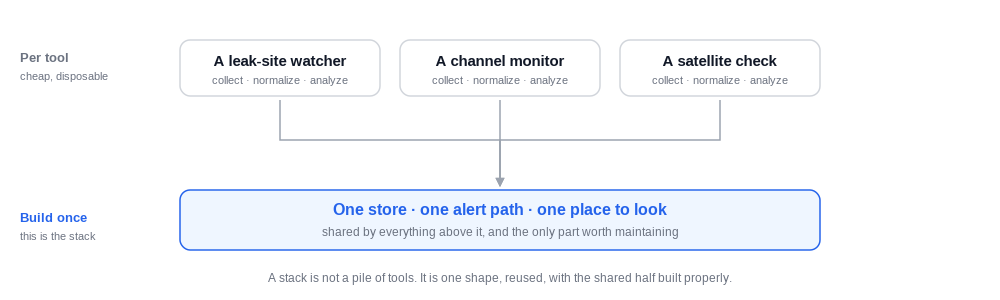
The front of the pipeline is genuinely different for every source. A leak site, a messaging channel, a satellite tile and a CSV export have nothing in common, and the code that fetches and flattens each one is throwaway by nature — the source will change and you will rewrite it. Fine. That code should be small enough that rewriting it is a morning.
The back of the pipeline is the same every time. Something has to keep what you collected, notice when a rule fires, and put it somewhere a person can look. Build that 3 times and you will maintain 3 of everything: 3 notification paths, 3 half-finished dashboards, 3 databases you are equally unsure about.
The stack is the shared half. Everything else is a connector.
The cheapest possible version of this
Build or buy
The honest answer is buy almost everything and build the thin layer that is yours.
| Thing | Default |
|---|---|
| Database, queue, scheduler | Buy or use the boring default. PostgreSQL and cron have never been the reason a project failed. |
| Dashboards and charts | Buy, until you have a question a generic tool cannot answer. Most people build a dashboard to avoid writing a query. |
| Alerting and chat delivery | Buy. Your chat tool already has a webhook. |
| Models | Rent, or run locally — see running AI locally for which and when. Do not train anything. |
| Visual workflow tools | Buy, and see automating without code for where they stop. |
| The collector for your specific source | Build. Nobody sells this and it is 40 lines. |
| Your normalization rules | Build. These encode your judgement about what the data means. |
| Entity resolution for your domain | Build. Generic deduplication will not know that 2 spellings are one organisation. |
The pattern: buy the infrastructure, build the judgement. Anything that encodes what you think a record means is the part only you can write, and it is usually the smallest part by line count.
The trap on the buy side is lock-in through convenience. A hosted tool that holds your collected data and offers no real export is not a tool you bought, it is a tool you rent your own archive from. Check the export path before the first row goes in — not because you plan to leave, but because the day you need to leave is never a calm day.
What I deliberately do not automate
This is the section I would keep if the rest were cut.
Verification. Not once, not partially, not “with a human reviewing the summary.” A claim becomes usable when a person has looked at the source material and decided. Every system here narrows a pile; none of them closes one.
Anything behind a login that is not mine. Automating an authenticated session ties every request to a real identity and usually breaks the terms I agreed to when I created the account. The technical difficulty is not the constraint here.
Anything where being wrong is expensive and being slow is not. If a mistake gets published, the 90 minutes automation saves are not worth the correction.
Collection at a volume I cannot review. A pipeline that produces more than I can look at has not helped me, it has given me a backlog and the feeling of coverage. If the triage queue is growing faster than I empty it, the answer is to collect less, not to add another classifier.
The first week of a new source. I watch it by hand until I understand what its normal looks like. You cannot write a rule for “unusual” without that, and every silent-failure alarm depends on knowing what a quiet day looks like.
Terms of service and rate limits are not technical problems
They are decisions made before the code, and they do not become more acceptable because your scraper is polite. Read what the source publishes about automated access. Check whether collecting at scale changes what the data is under the rules that apply where you work. If you need an answer you do not have, ask someone whose job it is — before there is a database full of something.
A rate limit, separately, is a message. Hitting one is the source telling you your assumptions about it were wrong. Slow down first and route around second; reaching sources that block you is about telling apart the 6 things that look like a block.
What it costs to run
The fair answer is that the software is nearly free and the attention is not.
The infrastructure for everything in this series runs on one machine and a handful of accounts you probably already have. A database costs nothing. A scheduler costs nothing. Chat delivery costs nothing. The real line items are narrower than people expect:
- A server, if you want collection to continue while your laptop is shut. The smallest tier of anything will do for the collection half; the model work is what needs hardware.
- Model usage, if you rent it. This is the one that surprises people, and it scales with how much you feed it rather than how many tools you have. A single unattended bulk run against a paid provider is how most people discover their real monthly number.
- Storage, which is the cheapest line and the one worth over-provisioning. Keeping raw payloads is what lets you fix a parser without re-fetching a year of history.
- Local model hardware, if you go that route — a one-off cost instead of a monthly one, which changes the arithmetic completely at volume.
Fill this in with your own numbers
This section is deliberately unpriced. I am not going to quote a monthly figure I have not measured, and neither should you take one from a blog post. Run your own stack for a month with billing alerts on, then write the real table.
The useful exercise is not the total. It is the ratio: what fraction of the bill is model usage, and would running that step locally change it by enough to matter? For most analyst workloads the answer is yes, though the local-models post argues that money is the weakest reason to run locally.
The cost nobody budgets is maintenance. A source changes its markup and a collector goes quiet. A model provider changes a default and an output shifts shape. None of that is expensive in money and all of it is expensive in the particular way that matters: it happens on a day you were doing something else.
What broke
Honest list, from the 12 systems in this series.
Silent collection failures, more than anything else. A selector stops matching, the job keeps exiting zero, and the dashboard shows you a calm, confident, entirely empty screen. This is the single most common way one of these tools has misled me, and the fix — alarm on zero, log what you parsed and not just what was new, send a heartbeat — is 3 lines and I have still had to learn it more than once.
Matching rules that were more confident than the data. A tool that marked a whole day’s rows as matched because one of them was. A map covered in places nothing happened, because numbers in text look like coordinates. Both produced fuller, better-looking answers than the truth, which is the dangerous direction for an error to run.
A scoring step that could not be repaired by tuning. Covered in does your AI step actually work: when one number ranks a wrong answer above a right one, moving the threshold removes the right answers first.
Storage growing without a policy. Media accumulating to tens of gigabytes without announcing itself, because retention was always going to be next week’s job.
What I would not build again
A dashboard before there was a question it answered. I have built several and used one. The store is the asset; the interface is a convenience, and a database query is a perfectly good interface for a long time.
A general-purpose framework for collectors. Twice I have started building the thing that would make writing the next collector fast, and both times the abstraction was wrong because the next source did not resemble the last one. Small duplicated scripts have aged better than any shared base class I have written.
Anything intended to be used by someone other than me, without asking them first. The tools in this series that get used are the ones where a person said “I keep having to do this.” The ones I invented for a problem I imagined are still in the repository, still working, still untouched.
Where to start
One source you check by hand more than twice a week. Not your most important one.
Write down the steps. Build the 40-line version. Let it run for a month, and fix the things that actually break rather than the things you imagine might. Then, when you add the second source, resist rewriting the first — instead, put the shared half somewhere both can use.
That is the stack. The rest is connectors.